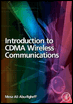
Introduction to CDMA Wireless Communications
Digital communications refer to the exchange of digital information (electronically) from one location (source) to another (destination). It requires an electronic system at the source to convert the information from its natural form in analogue such as a human voice video picture or music to digits such as binary-coded numbers, graphic symbols, microprocessor codes or data-base information. These digits are then processed (compressed, filtered, pulse shaped) to a form most suitable for sending (transmitting) over the media (channel). Consequently, the communication system carrying the digital information comprises of three main parts: processing and transmission at source; a communication channel over which the digital information is transmitted; and receiving and processing at the destination. Each application has its own communication system and the elements in the system are unique to the particular application. Modern communication systems are developed for application in mobile communications and ubiquitous networks for data communications.
The purpose of this chapter is to review the essential elements used in communication systems and based on spread spectrum techniques described in IS-95 and UMTS standards. The chapter starts with a reminder of the basics for the digital transmission theory in Section 2.2 and gradually introduces the reader to the principles of matched filtering in Section 2.2.6, and raised cosine pulse shaping in Section 2.2.9. Channel equalization techniques are dealt with in Section 2.3 and the modulation in Section 2.4. The digital modulation and demodulation used in IS-95 and UMTS standard-based system, such as the Quadrature...