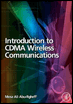
Introduction to CDMA Wireless Communications
By the end of the first decade of the new millennium, the population served by wireless mobile phones is expected to exceed that served by wire line. Clearly, to ensure fair use of the common radio resource, users must conform to a specific access technology. The implementation of efficient 'multiple access' schemes permit numerous users with diverse requirements to obtain network services simultaneously from the shared radio spectrum.
The origin of multiple access techniques has been around for some time (Viterbi, 1999), when Marconi's 'Tuned Circuit' was the enabling technology for Frequency Division Multiplexing (FDM). This was eventually developed into the Frequency Division Multiple Access (FDMA) technique where multiple modulated carriers provided separate channels.
Traditionally, this form of multiple access is based on the division of the available frequency band into a number of sub-bands, each containing the transmission from an individual user. Channels can be assigned on demand or on a permanent basis. The number of available channels limits the ultimate number of users accessing the system simultaneously. This scheme was used in first generation wireless networks such as the Total Access Connection System (TACS) in the UK.
The designers of satellite communications systems in the 1960s were faced with a dilemma when they used FDMA techniques. To make best use of limited satellite transmitter power, it was necessary to drive the on-board power amplifier into saturation. However, when multiple carriers arrived at the satellite simultaneously, the non-linearity of the amplifier generated inter-modulation products that cause distortion. Consequently,...