The Six Sigma Handbook: A Complete Guide for Greenbelts, Blackbelts, & Managers at all Levels

The management information
and statistical tools you need to
successfully implement Six
Sigma.
 TABLE OF CONTENTS
 A central concept in statistical process control is that every measurable phenomenon is a statistical distribution. In other words, an observed set of data constitutes a sample of the effects of unknown common causes. It follows that, after we have done everything to eliminate special causes of variations, there will still remain a certain amount of variability exhibiting the state of control. Figure 8.14 illustrates the relationships between common causes, special causes, and distributions.
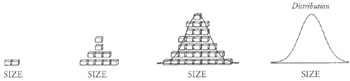
From Continuing Process Control and Process Capability Improvement, p. 4a. Copyright 1983 by Ford Motor Company. Used by permission of the publisher.
There are three basic properties of a distribution: location, spread, and shape. The location refers to the typical value of the distribution, such as the mean. The spread of the distribution is the amount by which smaller values differ from larger ones. The standard deviation and variance are measures of distribution spread. The shape of a distribution is its pattern peakedness, symmetry, etc. A given phenomenon may have any one of a number of distribution shapes, e.g., the distribution may be bell-shaped, rectangular-shaped, etc.
The central limit theorem can be stated as follows:
Irrespective of the shape of the distribution of the population or universe, the distribution of average values of samples drawn from that universe will tend toward a normal distribution as the sample size grows without bound.
It can also be shown that the average of sample averages will equal the average of the universe and...