Sound Insulation

3.5: Airborne Sound Insulation

3.5 Airborne Sound Insulation

Laboratory airborne sound insulation measurements are primarily used to compare the sound insulation provided by different test elements and to calculate the sound insulation in situ. The role of field measurements is usually to check that a certain level of sound insulation has been achieved.

3.5.1 Laboratory Measurements

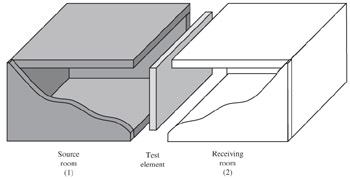
A transmission suite for airborne sound insulation measurements comprises two rooms; a source room and a receiving room separated by a test element (see Fig. 3.12). At this stage we simply assume that all sound is transmitted via the test element, and that the structure of the transmission suite itself plays no role other than defining the space for the source and receiving rooms.


Figure 3.12: Outline sketch of a transmission suite for airborne sound insulation measurements.

The transmission coefficient, ?, is defined as the ratio of the sound power transmitted by the test element, W 2, to the sound power incident on the test element, W 1,

(3.32)

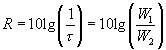
The sound reduction index, or transmission loss, R, in decibels is defined as

(3.33)

By assuming that the sound fields in the source and receiving room are diffuse we can calculate the incident and the transmitted sound powerfrom sound pressure level measurements in each room. To find these sound powers, the first step is to calculate the sound intensity incident upon any surface in a diffuse field in terms of the average sound pressure level in the room. This makes use of the...

UNLIMITED FREE
ACCESS
TO THE WORLD'S BEST IDEAS

SUBMIT
Already a GlobalSpec user? Log in.

This is embarrasing...

An error occurred while processing the form. Please try again in a few minutes.

Customize Your GlobalSpec Experience

Category: Acoustical Design Services
Finish!
Privacy Policy

This is embarrasing...

An error occurred while processing the form. Please try again in a few minutes.