Sound Insulation

The availability of measured dynamic or acoustic properties facilitates the choice of materials at the design stage. They are particularly useful in situations where consideration is being given to substituting one material or element in a construction with a different one.
Airflow resistance can be used to predict sound absorption by, and sound transmission through porous materials. The fundamental parameters describing resistance to airflow are given in Section 1.3.2.1.2.
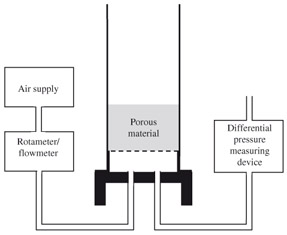
Two methods to determine the airflow resistance are described in ISO 9053. The most common method is the direct airflow method (Brown and Bolt, 1942). This uses an air supply (or vacuum) to produce a pressure drop across a specimen of porous material for which there is no temporal variation under steady-state conditions. Two measurements are required: the pressure drop between the two faces of the test specimen, and the volumetric airflow rate. To ensure a simple representative relationship between pressure and velocity for acoustic purposes it is necessary to ensure there is laminar (rather than turbulent) airflow. An example test cell is shown in Fig. 3.79; the dimensions and other details are described in ISO 9053.
An alternative method is the alternating airflow method (Venzke et al., 1972). This requires a device to produce a slowly alternating airflow in order to measure the alternating component of pressure in a volume enclosed by a...