Sound Insulation

Flanking transmission is omnipresent in buildings and its effects are not confined to any particular part of the building acoustics frequency range. In fact it is not uncommon for the flanking structure to radiate similar or higher sound power levels than the separating wall or floor itself.
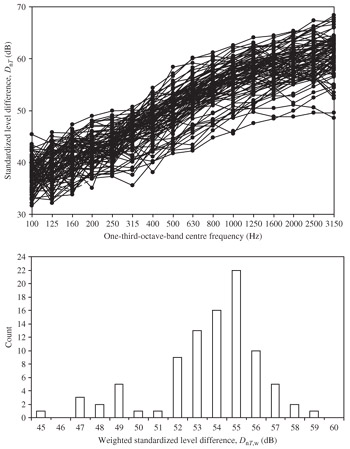
Figure 5.1 shows field measurements of airborne sound insulation for solid brick separating walls in dwellings with a variety of different flanking walls and floors. The variation is not only due to the different flanking constructions but also due to variation in workmanship, material properties, room dimensions, and measurement uncertainty. Sound insulation distributions of single-number quantities tend to be skewed towards lower values of sound insulation. The lower bound is only limited by the ingenuity of the builder to alter sound transmission paths and introduce new transmission paths through the quality of workmanship as well as by substitution of different materials to those that were specified. The wide range of results for the nominally identical separating wall illustrates the importance of understanding how the combination of direct and flanking transmission determines the in situ performance.