Standard Handbook for Aeronautical and Astronautical Engineers
Etienne Rapp
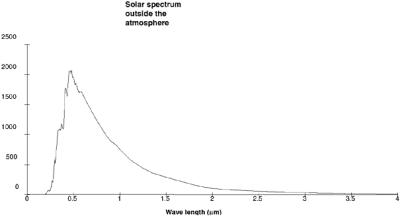
The average solar power per unit area received in the Earth's orbit is 1,368 W/m 2. This power decreases like the reciprocal of the square of the distance to the Sun (Figure 11.36 gives the Sun's spectrum). For distant missions it is insufficient, which compels use of RTGs. However, the European Space Agency has optimized cells developed for LILT (low intensity, low temperature) conditions to be used for the Rosetta mission for an insolation representing only 5% of the flux received on Earth.
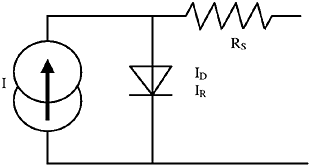
A photovoltaic cell (see Figure 11.37) is made from a p- n junction obtained by doping a crystalline or amorphous semiconductor material (space cells are all made on single crystal substrates). A metal layer forming the electric contact is applied to the rear face. On the front face, this contact has the form of a grid to let the light through. In addition, a low-reflecting coating is applied. This bare cell will be equipped with metal interconnectors (designed to assemble cells electrically with each other) and a coverglass to protect it from UV rays and ionizing radiation.
Photons are absorbed in the semiconductor material and convey their energy to the minority carriers of the semiconductor (electrons or holes). This energy is then used to cross the potential barrier and be collected by the metal contacts of...