Standard Handbook for Aeronautical and Astronautical Engineers
Chapter 3: Mechanical Engineering Principles

Section Editor: Mark Davies

PART 1. STATICS OF RIGID BODIES

Robert Paine

In general, the study of mechanics may be divided into two distinct areas. These are statics, which involves the study of bodies at rest, and dynamics, which is the study of bodies in motion. In each case it is important to select an appropriate mathematical model from which a "free body diagram" may be drawn, representing the system in space, with all the relevant forces acting on that system.

When a set of forces acts on a body, it gives rise to a resultant force or moment or a combination of both. The situation may be determined by considering three mutually perpendicular directions on the free body diagram and resolving the forces and moment in these directions. If the three directions are denoted by x, y, and z, then the sum of forces may be represented by ? F x, ? F y, and ? F z and the sum of the moments about respective axes by ? M x, ? M y, and ? M z. Then for equilibrium the following conditions must hold:

(3.1)
(3.2)

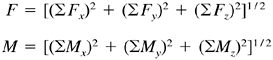
If the conditions in equations (3.1) and (3.2) are not satisfied, then there is a resultant force or moment, which is given by


The six conditions given in equations (3.1) and (3.2) satisfy problems in three dimensions. If one of these dimensions is not present (say, the z direction)...

UNLIMITED FREE
ACCESS
TO THE WORLD'S BEST IDEAS

SUBMIT
Already a GlobalSpec user? Log in.

This is embarrasing...

An error occurred while processing the form. Please try again in a few minutes.

Customize Your GlobalSpec Experience

Category: Hydraulic Cylinders
Finish!
Privacy Policy

This is embarrasing...

An error occurred while processing the form. Please try again in a few minutes.