Sucker-Rod Pumping Manual
Full of illustrations, tables, and formulas, this book will provide the reader with everything they need to ensure successful sucker-rod pumping operations.
 TABLE OF CONTENTS
 The subsurface pumps used in sucker-rod pumping work on the positive displacement principle and are of the cylinder and piston type. Their basic parts are the working barrel (cylinder), the plunger (piston), and two ball valves. The valve affixed to the working barrel acts as a suction valve and is called the standing valve. The other valve, contained in the plunger, acts as a discharge valve and is called the traveling valve. These valves operate like check valves and their opening and closing during the alterating movement of the plunger provides a means to displace well fluids to the surface.
Before a detailed review of the different pump types, it is important to have a basic understanding of a sucker-rod pump's operation. The discussion of the pumping cycle, i.e., the basic period of the pump's operation, is presented in connection with Figure 2-2. This figure depicts a common sucker-rod pump with the plunger moving inside a stationary barrel. The barrel is connected to the lower end of the tubing string, while the plunger is directly moved by the rod string. The positions of the barrel and the plunger, as well as the operation of the standing and traveling valves, are shown at the two extreme positions of the up-and downstroke. For simplicity of description, pumping of an incompressible fluid, i.e., liquid, is assumed.
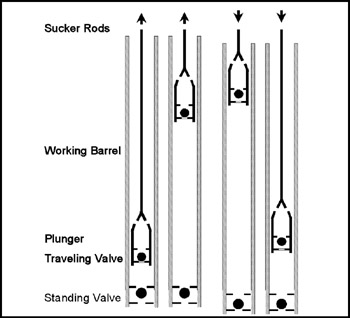
At the start of the upstroke, after the plunger has reached its lowermost position, the traveling valve closes due to...