Sucker-Rod Pumping Manual

Full of illustrations, tables, and formulas, this book will provide the reader with everything they need to ensure successful sucker-rod pumping operations.
 TABLE OF CONTENTS
 The pumping unit is the mechanism that converts the rotary motion of the prime mover into the reciprocating vertical movement required at the polished rod. Most types of pumping units utilize a walking beam, inherited from the days of the cable-tool drilling rigs. The nomenclature of pumping unit parts is given in Figure 2-47. Beam-type sucker-rod pumping units are basically a four-bar mechanical linkage, the main elements of which are:
the crank arm which rotates with the slow-speed shaft of the gear reducer
the pitman which connects the crank arm to the walking beam
the portion of the walking beam from the equalizer bearing to the center bearing
the fixed distance between the saddle bearing and the crankshaft
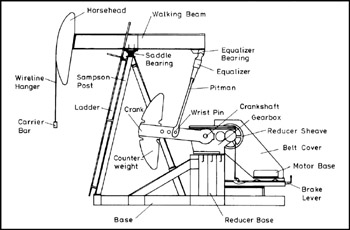
The operation of the above linkage ensures that the rotary motion input to the system by the prime mover is converted into a vertical reciprocating movement, output at the horsehead. The sucker rods, attached to the horsehead, follow this movement and drive the bottom-hole pump. Although there are different arrangements of pumping units available, all employ the same basic component parts detailed above.
Since the vast majority of pumping units used worldwide belongs to the beam-type class, the following sections will primarily deal with the structural and operational features of the several versions of these units. The ratings and other technical specifications of beam pumping units are covered by the American Petroleum Institute in its publications. Non-API pumping units are also available and are mainly used for...