Switchmode Power Supply Handbook, Second Edition

One of the most difficult problems in switchmode power supply design is to reduce the common-mode conducted RFI current to acceptable limits. This conducted electrical noise problem is mainly caused by parasitic electrostatic and electromagnetic coupling between the various switching elements and the ground plane. (The ground plane can be the chassis, cabinet, or ground return wire, depending on the type of unit.)
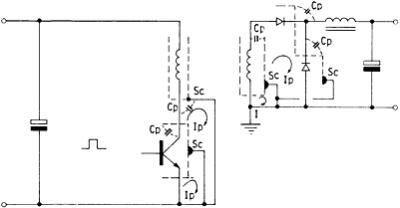
The designer should examine the layout, identify the areas where such problems may exist, and introduce at the design stage the correct screening methods, It is very difficult to correct for poor RFI design practices at a later stage. Likely problem areas are shown in Fig. 1.4.1, a diagram of the typical problem areas for parasitic coupling in a flyback SMPS. Suitable locations for Faraday screens are shown.
In most applications, Faraday screens will be required where high-frequency, high-voltage switching waveforms can capacitively couple to the ground plane or secondary outputs. Typical positions would be where switching transistors and rectifier diodes are mounted on heat sinks which are in contact with the main chassis. Further, where components or wires carry large switching currents, noise can be coupled by both magnetic and capacitive coupling. Other likely problem areas are output rectifiers; output chassis-mounted capacitors; and capacitive coupling between the primary, secondary, and core of the main switching transformer and any other drive or control transformers.