Switchmode Power Supply Handbook, Second Edition

If the auxiliary supply is used only to power the power supply converter circuits, it will not be required when the converter is off. For this special case, the main converter transformer can have extra windings to provide the auxiliary power needs.
However, for this arrangement, some form of start-up circuit is required. Since this start circuit only needs to supply power for a short start-up period, very efficient start systems are possible.
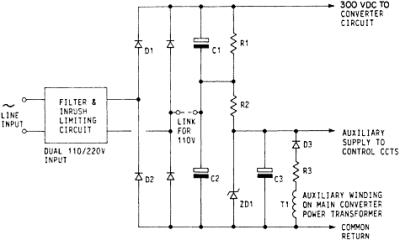
Figure 1.8.1 shows a typical dissipative start system. The high-voltage DC supply will be dropped through series resistors R1 and R2 to charge the auxiliary storage capacitor C3. A regulating zener diode ZD1 prevents excessive voltage being developed on C3. The charge on C3 provides the initial auxiliary power to the control and drive circuits when converter action is first established. This normally occurs after the soft-start procedure is completed.
The auxiliary supply is supplemented from a winding on the main transformer T1 when the converter is operating, preventing any further discharge of C3 and maintaining the auxiliary supply voltage constant.
A major requirement for this approach is that sufficient start-up delay must be provided in the main converter to permit C3 to fully charge. Further, C3 must be large enough to store sufficient energy to provide all the drive needs for correct start-up of the converter.
In this circuit, R1 and...