Switchmode Power Supply Handbook, Second Edition
When a power supply is first switched on, either from the line input switch or by electronic means (say from a TTL logic high signal), there will be a delay while the power and control circuits establish to their correct working conditions. During this period, it is possible for the output voltage to exceed its correct working value before full regulation is established, giving a turn-on voltage overshoot.
In most switchmode power supplies, a controlled start-up sequence is initiated at switch-on. Should the turn-on be from a line input switch, the first action will be inrush limiting, where a resistive element in series with the line input reduces the peak inrush currents for a few cycles while the input capacitors are charged up.
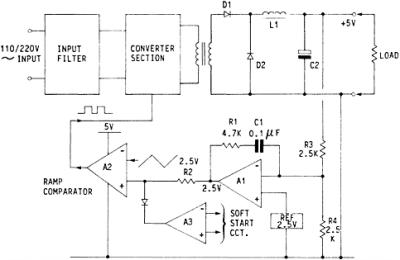
Following this inrush limiting, there will be a soft-start action. For soft start, the pulse width to the power switching devices is progressively increased to establish the correct working conditions for transformers, inductors, and capacitors. The voltage on the output capacitors is progressively increased with the intention of smoothly establishing the required output voltage. However, even under this controlled turn-on condition, it is possible for the output voltage to overshoot, as a result of race conditions in the control circuit as follows.
Figure 1.10.1 shows the output filter and control amplifier of a typical duty-cycle-controlled switchmode power supply. The control amplifier has a simple pole-zero compensation network to stabilize the loop.