Telecommunications Internetworking: Delivering Services Across the Networks
This book delivers the information you need to understand and be a player in today's and tomorrow's internetworked telecom.
 TABLE OF CONTENTS
 The telecommunications hub I refer to is a traffic concept that is used in vehicular and air transport traffic management. Traffic hubs serve as central points of distribution. In the case of air transport, airlines designate certain cities to serve as principal bases of operations, repair, and take-off/landing areas. In some cities, vehicles are brought into and out of the cities via a network of roadways that manage and distribute traffic as efficiently as possible.
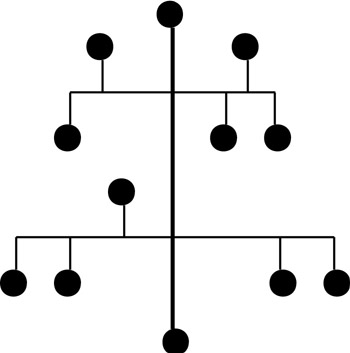
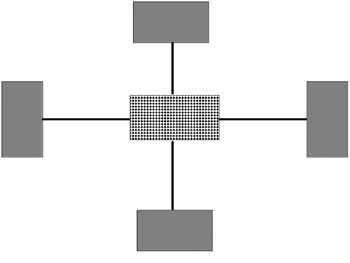
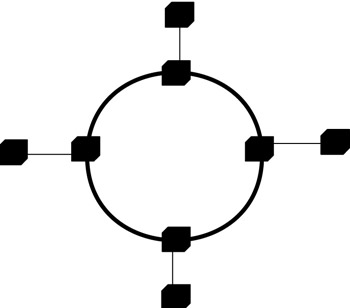
The telecommunications hub is a traffic-management tool employed to manage the distribution of information. Although images of a wheel are invoked when the word hub is used, the hub does not need to look like a wheel. The following diagrams (Figures 2-1 through 2-3) illustrate how information traffic can be distributed.
Each one of the aforementioned diagrams represents a generic traffic configuration. We will explore configurations types in more detail in the next chapter. What is important to understand is that the telecommunications hub is a central place or focal point for information dissemination/ traffic flow. The hub has value beyond traffic-management efficiencies or even call-processing efficiencies. The telecommunications hub serves as a point of network convergence.
Dissimilar networks (such as cable television, wireless, wireline, etc.) need to interconnect somehow. If interconnection does not occur, call flow or information flow from one network to another network cannot occur. Interconnection is the first step towards convergence convergence of technology, services,...