Telecommunications Internetworking: Delivering Services Across the Networks

This book delivers the information you need to understand and be a player in today's and tomorrow's internetworked telecom.
 TABLE OF CONTENTS
 Paging is usually considered to be the low end of mobile communications or the poor man s mobile communications. The paging concept was first conceived in 1939. The first practical and commercial unit was created in 1950 by Al Gross. The first commercial unit was licensed by the FCC in 1952. Paging is less expensive than other mobile communications systems because it was and still is primarily a one-way system. The paging receiver alerts the user to the call but does not verify or respond in any way to the base station. The cost and bulk of a typical mobile transceiver is due to the transmit portion, which is missing from a paging receiver; therefore, it can be small and cheap.
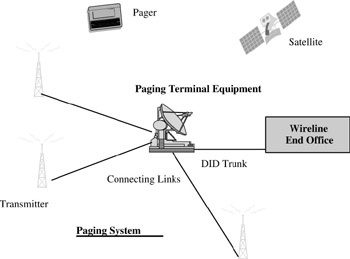
Paging has become a part of the mainstream consumer market. Executives and teenagers alike now use pagers that allow them to communicate wherever they are. This trend has given paging service providers cause to feverishly increase their subscriber base at a faster pace. Paging systems to date have satisfied most requirements for tone, numeric, and short alphanumeric messaging with sufficient subscriber capacity for the service providers. Cellular and PCS service providers are already integrating paging capabil- ities into their handsets. The challenge facing paging service providers is differentiating themselves. Pagers can either integrate low-quality voice messaging or expand their existing messaging and data capabilities. Figure 8-1 is a rendering of the Paging network.
New types of paging devices and enhanced protocols have led to...