Telecommunications Internetworking: Delivering Services Across the Networks
This book delivers the information you need to understand and be a player in today's and tomorrow's internetworked telecom.
 TABLE OF CONTENTS
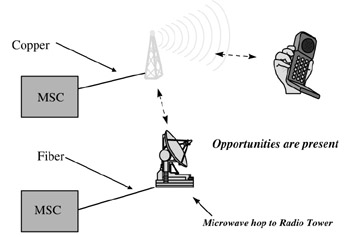
 Forms of wireless communication includes cellular, paging, personal communications services (PCS), land mobile radio, air-to-ground, local multi-point distribution service (LMDS), wireless local loop, and so on. The current dominant (in terms of usage and market penetration) wireless or mobile services are cellular, PCS, and paging. Cellular and PCS are closely related; therefore, they will both be discussed in one chapter. Paging will be discussed in Chapter 8. Figure 7-1 is a high level view of the cellular and PCS network.
In 1946, two-way mobile radio service was introduced. Soon after its introduction, the disadvantages of two-way mobile service became apparent. From a customer s or engineer s standpoint, the disadvantage was competition for RF channels and interference. The technical challenges were giving the subscriber a larger pool of RF channels to make their calls and reducing interference between subscribers. The simple solution could have been not to worry about giving subscribers more RF channels and to physically separate the radio coverage areas to ensure that there would be no overlap.
Instead, engineers from Bell Telephone Laboratories began to explore a concept that would reuse frequencies in small radio coverage areas. These coverage areas (called cells) would be linked together using a switch that would enable calls to be made while the telephone was moving. Computer and switching technology had to improve before mobile radio service became commercially viable. Availability was another issue, however; that was due to regulatory delays. Cellular telephones became...