Telecommunications Internetworking: Delivering Services Across the Networks
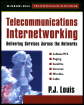
This book delivers the information you need to understand and be a player in today's and tomorrow's internetworked telecom.
 TABLE OF CONTENTS
 One of the binding forces of network interconnection is signaling. The network signaling I am referring to is the language in which service providers communicate with other service providers and with network elements within their own network. A more technically precise definition would be that signaling is the exchange of information in a telecommunications network (public and private) that establishes and controls the connection of a call or communication between subscribers or computing systems and also the transfer of subscriber/end-to-end and management (subscriber and network) information. In Chapter 1, What Is a Telecomunications Network? , I focused on describing Multi-Frequency (MF) signaling and Signaling System 7 (SS7) because they are the dominant network signaling protocols that are used by public telecommunications networks today. The reader should not be swayed into believing that there are no other signaling protocols, however. In fact, there are a number of industry-standardized signaling protocols. At this time, the most popular signaling protocols are as follows:
Other types of signaling are just as important. In general, signaling can be defined in the following ways: