Text Mining for Biology and Biomedicine
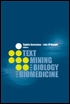
Packed with field-tested expertise and advice, this book describes the methods of natural language processing and their applications in the biological domain.
 TABLE OF CONTENTS
 Our review of recent research on rule-based extraction of relations (simple facts) and events from biotexts reveals that there are many types of approaches. These vary greatly in terms of the degree to which they incorporate linguistic information, and in their use of such information. They also vary greatly in terms of how they position themselves, with respect to the no parsing versus/partial/parsing versus full parsing debate. There is evidence of much experimentation with parsing strategies: full parsing on its own; full parsing followed by fall-back partial parsing; partial parsing followed by full parsing; partial parsing on its own; parsing applied to all sentences; parsing applied only to sentences judged relevant to the task; and so forth. There is a marked difference between pattern-matching approaches, on the one hand, and more NLPoriented approaches, on the other. NLP techniques become essential when there is a need to extract abstract representations of facts rather than matching fragments of text. Hybrid syntactic-semantic approaches offer promising results, particularly where these are based on a strong sublanguage approach. Ontology-driven approaches also are promising [62]. A system that combined a fully ontology-driven approach with a syntactic-semantic sublanguage-based approach would offer an interesting direction for future research. We have not yet seen such a system being applied to biotexts, although GenIE and GENIES represent different and overlapping aspects of such a system. Table 7.3 summarizes the various types of approaches.
| General Class | Subtype/Characteristics | Comments |
|---|---|---|
| Simple... |