Total Productive Maintenance
Clarifying what TPM is and what it is not, this reference clearly presents the economic value of TPM and shows how to calculate the Return on Investment (ROI) that a company can expect.
 TABLE OF CONTENTS
 This chapter looks at factors that are important for measuring the results of a maintenance improvement program. The first challenge is to select the maintenance indicators that should be used. Consultants will try to sell their clients on hundreds of different indicators. Although there are so many indicators, the focus should be on the financial bottom line. The total measure of maintenance performance is the percent of sales dollars spent on maintenance. In the case of facilities, that measure is the maintenance cost per square foot maintained. This total measure is critical to meeting one of the goals of world class manufacturing or service: providing all products and services at the lowest cost.
If a competitor has a maintenance cost equal to 4% of the sales dollar and your maintenance cost is 7%, then the competitor enjoys a 3% advantage. That competitor can use that advantage to increase profit, reduce price, fund new capital investment, or expand research and development. That difference puts your company at a definite disadvantage.
Three main categories of indicators can be used to measure performance:
Financial
Effectiveness
Performance
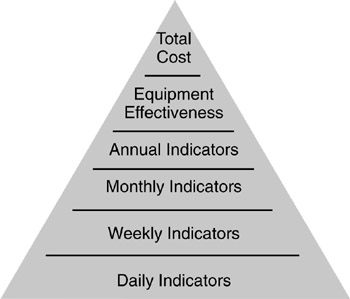
The relationship among the various types of indicators is pictured in Figure 13-1. Each level highlights an indicator. The cause of any problem and the subsequent solution is provided by examining the indicators in the next lower level. By the time any problem reaches the bottom level either the supervisor, planner, or craft technicians should be able to provide a solution.