Understanding Water Quality Management: Technology & Applications

Hydrothermal processes refer to aqueous treatment of wastewaters at elevated temperatures and pressures. Four basic operating technologies are in use or have been investigated in the laboratory:
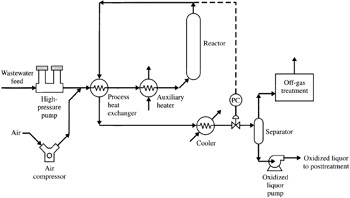
Wet air oxidation (WAO). A commonly used process for more concentrated wastes, especially those that are toxic and/or biologically refractory. These processes use an oxidant, primarily oxygen from air, to partially oxidize organics, yielding a variety of low-molecular-weight organic acids (readily biodegradable). Temperatures typically range from 150 to 320 C and pressures from 150 to 3000 psig. This process is shown in Figure 6.12. In wet air oxidation the wastewater and an air stream are fed under high pressure, through heat exchangers to a reactor in which the wastewater and air mixture oxidizes under high temperature and pressure. This mixture may be recirculated (see Figure 6.12) several times before oxidation has reached a satisfactory state. The mixture is then conveyed to an air/fluid separator and the resulting air and water streams are subject to additional treatment.
Figure 6.12: Wet Air Oxidation Flow Schematic [15].
The catalyzed wet air oxidation (CWAO) process is a variation on the wet air oxidation process. Chemical contaminants are oxidized in the liquid phase by contacting the liquid with high-pressure air at temperatures that are typically between 120 C and 310 C. The liquid phase and high-pressure air are passed over a stationary bed of catalyst. The operating pressure is maintained such that the reaction takes place in the liquid phase. This enables the oxidation processes to...