Understanding Water Quality Management: Technology & Applications

A wide variety of food-processing wastewater, including meat, poultry, dairy, brewery, and winery wastewaters, has been applied successfully to the land. By 1979, there were an estimated 1200 private industrial land treatment systems. Disposal of industrial wastes by irrigation can be practiced in one of several ways, depending on the topography of the land, the nature of the soil, and the characteristics of the waste:
Distribution of waste through spray nozzles over relatively flat terrain
Distribution of waste over sloping land that runs off to a natural watercourse
Disposal through ridge and furrow irrigation channels
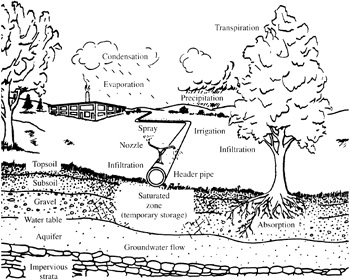
Screened waste is pumped through laterals and sprayed through sprinklers located at appropriate intervals, as shown in Figure 11.1. The waste percolates through the soil, and during this process the organics undergo biological degradation. The liquid is either stored in the soil layer or discharged to the groundwater. Most spray irrigation systems use a cover crop of grass or other vegetation to maintain porosity in the upper soil layers. The most popular cover crop is reed canary grass ( Phalaris arundinacea). This grass develops an extensive root system, has a relatively large leaf area, and is tolerant of adverse conditions. There is a net waste loss by evapotranspiration (evaporation to the atmosphere and absorption by the roots and leaves of plants). This may amount to as much as 10% of the waste flow.
Loamy well-drained soil is most suitable for...