USB Design by Example: A Practical Guide to Building I/O Devices, Second Edition

In this chapter, we transform the theoretical I/O device from Chapter 3 into several practical implementations. I used the word choosing in the chapter title to imply that we will be buying ready-made USB building blocks rather than starting one from silicon upwards. The I/O device designs described in this book will use some of the many commercially available USB components. If you are a silicon designer, contact the USB Implementers Forum and inquire about their Transceiver Macrocell Program.
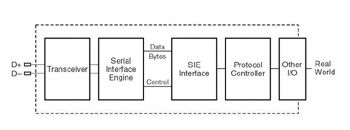
The block diagram of an I/O device, repeated in Figure 4-1 for your convenience, consists of several independent elements that I shall describe from the USB cable connection to the real world. These elements can be integrated into four basic catagories of device, and there are multiple variants within these catagories. The good news is that the ideal combination that you require probably exists the bad news is that you have to choose one!
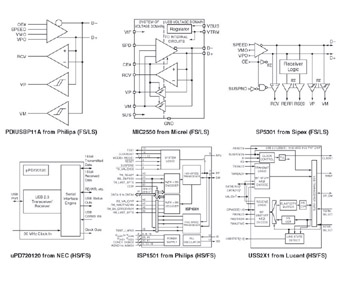
A USB transceiver must meet the electrical characteristics of the bus. There are two fundamentally different types of transceiver component: the low-/full-speed transceiver is shown in the upper half of Figure 4-2, and the full-/high-speed transceiver is shown in the lower half of Figure 4-2. These transceivers convert between the differential, bidirectional signaling on the bus and the single-ended, unidirectional, TTL/CMOS voltage levels of the Serial Interface Engine.
The low-/full-speed...