Vibration Spectrum Analysis: A Practical Approach, Second Edition

This author has spent many years lecturing to different groups of people who were interested in spectrum analysis for problems ranging from detailed physical tests of cavitation phenomena to philosophical questions about why the walls, of Jericho fell. Often, a very simple explanation involving pulse theory has sufficed to explain some of the observed phenomena. This section is designed to give the reader food for thought rather than quantitative answers.
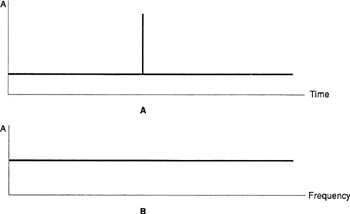
The most commonly discussed pulse is probably the impulse. The unit impulse is a mathematical fiction and is shown in the time domain representation of Figure B.1a as having an amplitude of 1 unit and a width of 0 sec. The Fourier transform of a single impulse is pure white noise in the frequency domain. Since white noise has equal amplitude at all frequencies, the energy of the impulse is spread rather thin, yielding a low amplitude of white noise at all frequencies (see Figure B.1b).
Since we know that nothing in nature happens over a zero time duration, it makes sense to talk about a pulse of finite width. Figure B.2a shows a pulse of time width T sec. Note that the frequency domain of the pulse looks very different from the pure white noise spectrum caused by an impulse. Examination of Figure B.2b shows a series of lobes in the frequency domain. The first lobe contains most of the total energy of the pulse and rolls off...