Vibration Spectrum Analysis: A Practical Approach, Second Edition

The wearing parts of a machine such as the gears, hydraulic pistons, bearings, and wear rings generate fine metal particles during normal operation. At the onset of a severe wear mode the particle size increases and the appearance of the particles change. Knowledge of particles and how they relate to the mode of wear (tribology) permits a trained analyst to determine the wear status in a machine by measuring the fine and coarse metal particles and then examining the particles under a microscope. The testing for wear metals for condition monitoring and predictive maintenance are tested predominantly in the following ways:
Spectrochemical Analysis
Wear Debris Analysis/Ferrography
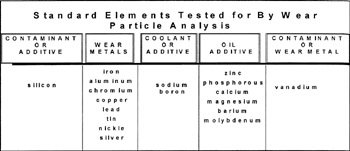
Spectrometric Analysis Technique for detecting and quantifying metallic elements in used oil resulting from wear, contamination, and additives. The oil sample is energized to make each element emit or absorb a quantifiable amount of energy, which indicates the element's concentration in the oil. The results reflect the concentration of all dissolved metals (from additive packages) and particulate (Figure I.3). This test is the backbone for all oil analysis laboratories today, as it provides information on machine, contamination and wear condition relatively quickly and accurately.
As important as the spectrometer is to oil analysis, it has a severe limitation. In its normal operation, it only sees dissolved metals and the finest debris, which are generally associated with benign or normal wear. Coarse particles are of greater interest because they usually are generated by...