Water Distribution Systems Handbook

Kevin Lansey
Department of Civil Engineering and Engineering Mechanics
University of Arizona
Tucson, AZ
Larry W.Mays
Department of Civil and Environmental Engineering
Arizona State University
Tempe, AZ
In developed countries, water service is generally assumed to be reliable and utility customers expect high-quality service. Design and operation of water systems require an understanding of the flow in complex systems and the associated energy losses. This chapter builds on the fundamental flow relationships described in Chap. 2 by applying them to water distribution systems. Flow in series and parallel pipes is presented first and is followed by the analysis of pipe networks containing multiple loops. Water-quality modeling is also presented. Because solving the flow equations by hand for systems beyond a simple network is not practical, computer models are used. Application of these models is also discussed.
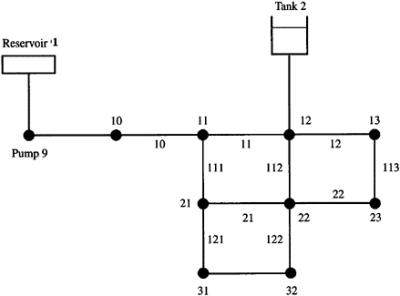
A water distribution system consists of three major components: pumps, distribution storage, and distribution piping network. Most systems require pumps to supply lift to overcome differences in elevation and energy losses caused by friction. Pump selection and analysis is presented in Chap. 5, Storage tanks are included in systems for emergency supply or for balancing storage to reduce energy costs. Pipes may contain flow-control devices, such as regulating or pressure-reducing valves. A schematic of a distribution system is shown in Fig. 4.1.
The purpose of a distribution system is to supply the...