Water Distribution Systems Handbook

The vulnerability of a network to a mechanical failure (e.g., a burst pipe) can be defined as the magnitude of the shortfall in the water supplied to consumers as a result of the failure. Although most networks exhibit a degree of resilience, whereby flows are redistributed within the network to compensate for the loss of the failed component, the continued and full delivery of all water demands may not be possible, depending on which specific component has failed.
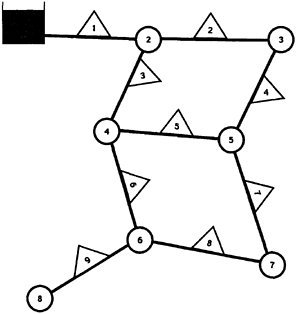
For example, a burst pipe in link 1 of the network depicted in Fig. 18.8 will result in a complete failure of the system, with all consumers experiencing interruption of supplies while the pipe is repaired. By comparison, a burst pipe in link 9 of the same network will result in a localized failure; thus, only a relatively small number of consumers will be affected (unless demand node 8 corresponds to a substantial portion of the consumers serviced by the network). This suggests that link 1 is far more important than link 9 because the consequences of a failure in link 1 are significantly greater.
Bouchart and Goulter (1989) defined the link importance (LI i ) measure for a given link i as the proportion of the demand in the network as a whole that is not supplied when the link in question has failed.
The link importance of a given link i is calculated as
| (18.33) |