Water Distribution Systems Handbook

Lindell E.Ormsbee and Srinivasa Lingireddy
Department of Civil Engineering
University of Kentucky,
Lexington, KY
Computer models for analyzing and designing water distribution systems have been available since the mid-1960s. Since then, however, many advances have been made with regard to the sophistication and application of this technology. A primary reason for the growth and use of computer models has been the availability and widespread use of the microcomputer. With the advent of this technology, water utilities and engineers have been able to analyze the status and operations of the existing system as well as to investigate the impacts of proposed changes (Ormsbee and Chase, 1988). The validity of these models, however, depends largely on the accuracy of the input data.
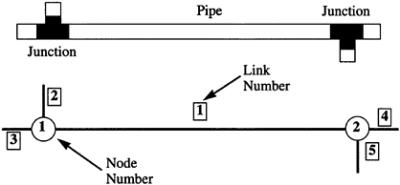
Before an actual water distribution system can be modeled or simulated with a computer program, the physical system must be represented in a form that can be analyzed by a computer. This normally requires that the water distribution system first be represented by using node-link characterization (Fig. 14.1). In this case, the links represent individual pipe sections and the nodes represent points in the system where two or more pipes (links) join together or where water is being input or withdrawn from the system.
Data associated with each link will include a pipe identification number, pipe length, pipe diameter, and pipe roughness. Data associated with each junction node will include a junction identification number, junction elevation,...