Water Loss Control Manual

With numerous tables, diagrams, charts, graphs, photographs, and basic explanations, this book examines every aspect of water loss and provides simple, effective, tested solutions.
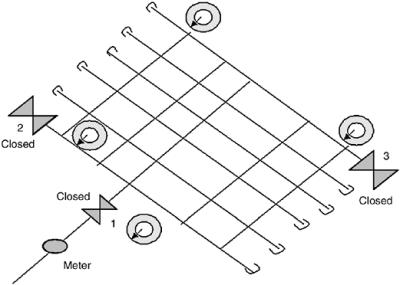
Flow analysis, step testing, and zoning analysis has been practiced for many years. The analysis involves setting up either permanent or temporary zones (see Figs. 10.18 and 10.19) and then analyzing the relationship of flows within the zones. In North America the zones often tend to be fairly large and temporary, as operators do not like their systems shut in, for water quality and fire-fighting reasons. In Europe, operators tend to operate small permanent zones on a continual basis.
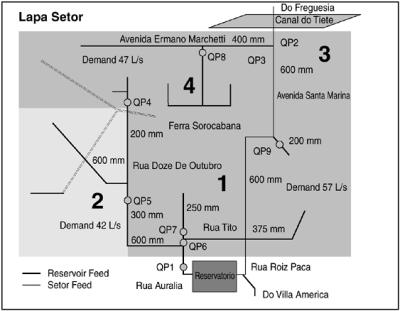
A simple way to compare flows to determine if an area has high leakage is to determine the nighttime flows as a percentage of the average daytime flows. If the percentage is high, the potential for leakage is high. See Figs. 10.20 and 10.21. This method is very system- and zone-dependent, as obviously some areas (in particular, industrial areas) could have 24-h consumers who form a large part of the daily flow pattern. In this case the operator would identify all of the zones with high night/day flow relationships and then program them for leak pinpointing. Once leaks have been repaired and the flows returned to what would be considered a normal ratio, the zones are monitored to see if and when the leakage returns. Then the next intervention can be scheduled. Another way to use night flows is...

 TABLE OF CONTENTS