Wavelets: A Primer

Enhanced by numerous illustrations and fully worked examples, this text provides a solid mathematical foundation for the broad range of applications enjoyed by the wavelet transform.
 TABLE OF CONTENTS
 The approximation, resp. the representation, of arbitrary known or unknown functions f by means of special functions can be viewed as a central theme of analysis. "Special functions" are functions taken from a catalogue, e.g., monomials t ? t k, k ? ?, or functions of the form t ? e ct, c ? ? a parameter. As a rule special functions are well understood, very often they are easy to compute and have interesting analytical properties; in particular, they tend to incorporate and re-express the evident or hidden symmetries of the situation under consideration.
In order to fix ideas we consider a (given or unknown) function

assuming that f is sufficiently many times differentiable in a neighbourhood U of the point a ? ?. Such a function can be approximated within U by its Taylor polynomials
| (1) | 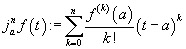 |
( jets for short), up to an error that can be quantitatively controlled, and under suitable assumptions the function f is actually represented by its Taylor series, meaning that one has
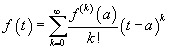
for all t in a certain neighbourhood U' ? U.
The general setup in this realm is the following: Depending on the particular situation at hand one chooses a family ( e ? ? ? I) of basis functions t ? e ?( t); the index set I may be a discrete or a "continuous"...