Wavelets: A Primer

Enhanced by numerous illustrations and fully worked examples, this text provides a solid mathematical foundation for the broad range of applications enjoyed by the wavelet transform.
 TABLE OF CONTENTS
 A function ? : ? ? ? satisfying the conditions
| (1) | 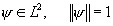 |
and
| (2) | 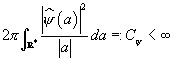 |
is called a mother wavelet or simply a wavelet. These two conditions represent the bare minimum that is necessary for the functioning of the theory described in this chapter. All wavelets occurring in practice are L 1-functions as well, most of them are continuous (the Haar wavelet isn't), many are differentiable, and the wavelets that are the most popular (as mathematical objects, if not in the applications) have compact support.
Whether a proposed function ? ? L 2 fulfills condition (2) cannot be decided just by looking at it. That's why the following criterion is of help, at least for reasonable ?'s; at the same time it gives an intuitively accessible interpretation of condition (2):
For functions ? ? L 2 satisfying t ? ? L 1 , i.e., ? t ?( t) dt < ?, condition (2) is equivalent to
| (3) |  |
According to this proposition a wavelet has mean value 0. From this we infer that the graph  of a wavelet ? lies, as most graphs of "waves" do, partly above and partly below the t-axis.
? A function ? of the described kind is automatically in L 1, and one has
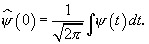
By (2.9) the Fourier transform  is continuous. Then the integral (2) can only converge if
  .
.
Conversely: The condition t