Wavelets: A Primer

Enhanced by numerous illustrations and fully worked examples, this text provides a solid mathematical foundation for the broad range of applications enjoyed by the wavelet transform.
 TABLE OF CONTENTS
 The most important tool in the construction of wavelet theory is Fourier analysis. The subsequent chapters rely on many of the well-known theorems and formulas relating to Fourier series, as well as on a basic understanding of the Fourier transform on ?. These ideas will be presented in the following sections in the way of a review, so that they can readily be used later on. For the corresponding proofs we refer the reader to the pertinent textbooks, e.g., [2], [5], [10], [15]. In Sections 2.3 and 2.4 we give an account of the Heisenberg uncertainty principle and of the Shannon sampling theorem. These two theorems point to certain definitive limits of signal theory, and, in consequence, they also also play a decisive, if sometimes hidden, role in all work with wavelets.
As our basic environment we use the function space  ? L 2( ?/2 ?). The points of this space are measurable functions f: ? ? ?, which are 2 ?-periodic:

and for which the integral
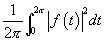
is finite. To be precise, the space  consists of equivalence classes of such functions; two functions f and g differing only on a set of t-values of measure 0 are considered to be the same point in
  . Among other things, this has the following consequence: A function
  , about which nothing more specific is known, has no definite values at individual points. Under these circumstances, it makes no...