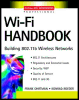
Wi-Fi Handbook: Building 802.11b Wireless Networks
The best guide to designing and building Wi-Fi.
 TABLE OF CONTENTS
 The successful deployment of an 802.11 system requires design, planning, implementation, operation, and maintenance. This chapter is provided as a very brief overview of what the wireless network planner needs to deploy an 802.11 network.
Many vendors are available with equipment that uses several different 802.11 standards. How does one make sense of it all? The most common protocol in use today is 802.11b. But is it best for my application? Many wireless Internet service providers (WISPs) such as T-mobile have phased out all 802.11 (FH) access points (APs). Much of this gear is available on the surplus market. Is there any merit to using this technology? Two new protocols are currently emerging: 802.11g and 802.11a. Is there a reason to wait for these to become publicly available and fully certified before interworking them? The short answer to this question is that it depends on the application and the requirements for that application.
Some of the questions that must be addressed in selecting an 802.11 solution lead to trade-offs, such as speed versus range. Others have mutually exclusive answers, such as proprietary- versus standards-based extensions. Some of the questions that need to be addressed are: What is the network topology? What kinds of links will be used? What is the environment like? What are the throughput, range, and bit error rate that are needed? Will you need tolerance for multipath? Which frequency band will be used with which protocols? Can the solution be off-the-shelf or surplus standards-based,...