Wi-Fi Handbook: Building 802.11b Wireless Networks
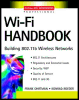
The best guide to designing and building Wi-Fi.
 TABLE OF CONTENTS
An objection often raised about 802.11 applications is that because the spectrum used by 802.11 (2.4 GHz for 802.11b and 5.8 GHz for 802.11a) is unlicensed, it will inevitably become overused (called tragedy of the commons) to a point of being unusable at which time the government (U.S. or other) will step in to control the spectrum, making it no longer free, thus costing the service provider his or her profit margin and relegating the market to deep-pocketed monopolists.
This chapter explores the considerations wireless service providers should take into account when deploying service on unlicensed 802.11 bands. Next, it explores a new initiative from the Federal Communications Commission (FCC), which heralds a change to spectrum management that may actually serve to liberalize the FCC's approach to what spectrum is unlicensed. Finally, the chapter covers an initiative in the U.S. Congress to free more spectrum for the use of broadband wireless Internet applications. If anything, it appears that the U.S. government is developing a policy to encourage the use of unlicensed spectrum.
Even though 802.11 operates in unlicensed spectrum, a service provider must know a number of things in order to stay out of trouble with state and federal authorities. The following paragraphs outline the most prominent problem areas.
Spectrum is managed by a number of different organizations. The most visible to the general public is the FCC. The FCC manages civilian, state, and local government usage of the radio spectrum. The FCC regulations...