Wi-Fi Handbook: Building 802.11b Wireless Networks
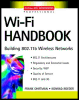
The best guide to designing and building Wi-Fi.
 TABLE OF CONTENTS
 Eventually, the Internet will replace the Public Switched Telephone Network (PSTN), but many technological changes will have to take place in order for this forecast to come to fruition. One major element will be the establishment of a faster connection to the Internet from the residence and small enterprise. In the foreseeable future, broadband Internet access will be limited if it is to be delivered by the duopoly of cable modems and Digital Subscriber Lines (DSLs).
802.11 and associated wireless technologies pose the greatest promise for a relatively rapid rollout of ubiquitous broadband Internet access. Clayton Christensen's definition of disruptive technology is that which is "cheaper, simpler, smaller, and more convenient to use." When compared, infrastructure-wise, to DSL (from the telephone company) and cable modems, 802.11 undoubtedly meets Christensen's definition.
Four major objections have been made to the proposal to adopt 802.11 as a Last Mile solution, that is, access to a greater network, be it the Internet or the PSTN. Those objections are range, security, quality of service (QoS), and concern over interference from other Part 15 users in the unlicensed spectrum. In order to replace the PSTN's copper wire or cable TV's coax cable as Last Mile access, 802.11 as a technology must meet or exceed the performance of those forms of access. In addition, 802.11 has qualities of its own where its adoption will outweigh any disadvantages it has vis- -vis copper wire or cable's coax.
One of the...