Wind Turbine Control Systems: Principles, Modelling and Gain Scheduling Design

In this appendix, we summarise the more relevant concepts of optimisation with constraints expressed in the form of linear matrix inequalities (LMIs). Currently, this branch of convex optimisation is extensively used in control, especially in robust and LPV gain scheduling control. The aim of this appendix is to provide the interested reader with the basic tools of optimisation with LMIs used in LPV controller synthesis.
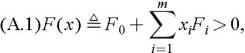
An LMI is defined as
where
F 0 , ,F m are real symmetric matrices of dimension n n,
x 1 , ,x m are real scalar unknowns called decision variables,
and the inequality symbol > 0 denotes F ( x) is positive definite , i.e.,all eigenvalues of F( x) are positive.
It is also possible to define LMIs of the form
as well as non-strict LMIs such as
where F( x) and G( x) are affine in x. Note that inequalities (A.2) and (A.3) are actually special cases of the definition (A.1). The matrix inequality (A.2) can be written as the inequality ? F( x) > 0 and (A.3) as F( x) ? G( x) > 0.
Further, multiple LMIs,
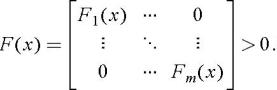
can be expressed as a single LMI of the form (A.1), i.e.,
Since the set of eigenvalues of F( x) is the union of the sets of eigenvalues of F 1