Wireless Communications Security

Security is a critical issue in mobile radio applications both for the users and providers of such systems. Although the same may be said of all communications systems, mobile applications have special requirements and vulnerabilities, and are therefore of special concern. Wireless networks share many common characteristics with traditional wire-line networks such as public switch telephone/data networks, and therefore, many security issues with the wire-line networks also apply to the wireless environment. Wireless networks, while providing many benefits over their wired counterparts, including the elimination of cabling costs and increased user mobility, present some serious security concerns. Unlike wired networks, where the physical transmission medium can be secured, wireless networks use the air as a transmission medium. This allows easy access to transmitted data by potential eavesdroppers. The mobility of wireless networks also introduces problems. The mobility of users, the transmission of signals through the open-air and the low power consumption of the mobile user bring to a wireless network a large number of features distinctively different from those seen in a wire-line network. Issues of security and privacy become more prominent with wireless networks.
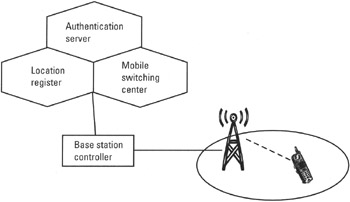
A simple mobile environment is shown in Figure 3.1.
Generally the following components are found in the mobile network environment:
Mobile station (MS): A mobile terminal or mobile station is the equipment used by a client to obtain service from the mobile network. If he is within the coverage range of his mobile service provider,...