Wireless Communications Security

We now introduce the basic concepts and terminology of cryptology.
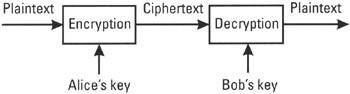
To achieve secrecy over a public channel, Alice scrambles her message, usually known as plaintext, according to some preestablished rules, which are determined by a key shared in advance with Bob. After receiving the enciphered message, Bob unscrambles it, according to preagreed rules represented by his key, and recovers the plaintext. The processes of scrambling and unscrambling the message are called encryption and decryption, respectively. The scrambled text is called the ciphertext. This process is shown in Figure 2.1.
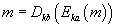
The ciphertext should provide Eve with no knowledge on the real message exchanged between Alice and Bob. Mathematically, we denote the encryption of a message m with a key ka by an encryption method E( ) by:
and the decryption of the same message m with a key kb by a decrypting algorithm D( ) by:
Encryption algorithms are also known as enciphering algorithms, and ciphers.
A scheme, such as the one shown in Figure 2.1, is called a cryptosystem. If the keys used to encrypt and decrypt are the same, the cryptosystem is called a symmetric key one. If they are different, it is called an asymmetric key cryptosystem. The most common symmetric key cryptosystems are block ciphers and stream ciphers.
Block ciphers operate on the plaintext in groups of bits (blocks of bits) while stream ciphers operate...