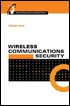
Wireless Communications Security

In the previous chapter, security considerations and mechanisms of second generation mobile systems were discussed. Here, we discuss the security of third generation systems (3G) and briefly introduce fourth genereation wireless communication systems (4G). 3G systems bring to the user multimedia communications, mobile commerce, among many other applications, in the wireless environment.
Third generation mobile communication systems are called by several different acronyms 3G, UMTS, IMT2000 and W-CDMA, to name a few. The promises of third generation mobile phones are fast Internet surfing, advanced value- added services and video telephony. 3G includes capabilities such as enhanced multimedia (voice, data, and video), a wide range of services (i. e. e-mail, paging, fax, video-conferencing, and web browsing), broad bandwidth, high data transmission speed (up to 2 Mbps), routing flexibility (repeater, satellite, LAN), operation at 2 GHz transmit and receive frequencies, and roaming capability throughout Europe, Asia and North America.
3G technology improves upon 2G systems in many ways. For example, it moves towards packet switching from circuit switching. Packet switching uses the communication system more effectively, therefore boosting its capacity. Packet switching also enables users to be online continuously. Via careful use of the frequency spectrum and inventive coding methods, 3G technology is supposed to achieve bit rates up to 2 Mbps. Essential qualities and characteristics of a 3G wireless system are:
Bit rates reaching up to 2 Mbps;
Variable bit rate to offer bandwidth on demand;
Multiplexing of services with different quality requirements on a single...