Wireless Technology Basics: Signals, Modulation Types, and Access Technologies

Radio modulation is the process of modifying the characteristics of a radio carrier wave (electromagnetic wave) using an information signal (such as voice or data). The characteristics that can be changed include the amplitude modulation (AM), frequency modulation (FM), or phase modulation (PM). A pure radio carrier signal carries no information. When the radio signal is modified from a normalized state, it is called a modulated signal (thus containing information). This modulated signal is the carrier of the information that is used to modify the carrier signal. When the radio carrier is received, its signal is compared to an unmodulated signal to reverse the process (called demodulation). This allows the extraction of the original information signal.
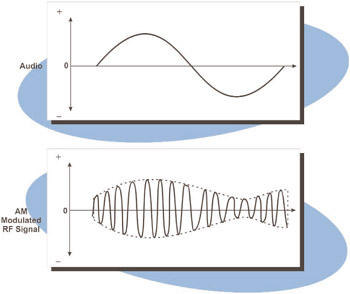
Amplitude modulation is the transferring of information onto a radio wave by varying the amplitude (intensity) of the radio carrier signal.
Figure 1.6 shows that amplitude modulation involves the transferring of information onto a carrier signal by varying the amplitude (intensity) of the carrier signal. This diagram shows an example of an AM modulated radio signal (on bottom) where the high of the radio carrier signal is change by using the signal amplitude or voltage of the audio signal (on top).
Frequency modulation is the process of transferring an information signal onto a radio carrier wave by varying the instantaneous frequency of the radio carrier signal. In 1936, the inventor Armstrong demonstrated an FM transmission system that was much less susceptible to noise signals...