Wireless Technology Basics: Signals, Modulation Types, and Access Technologies

Antennas convert electrical signals into electromagnetic waves that travel through the air. Antennas must be designed specifically according to the frequency of the application. The most obvious design parameter for an antenna is the size or length of the antenna. All antennas have an optimal relation to the size of one radio wave (wavelength) of the frequency in question. The higher the frequency the smaller the wavelength, and the smaller the antenna can be. At 800 MHz (the cellular frequency) the natural wavelength is about 15 inches. A popular cellular antenna size is the 1/4 wave antenna. This results in a cellular antenna being approximately 9 cm (3 1/2 inches) long.
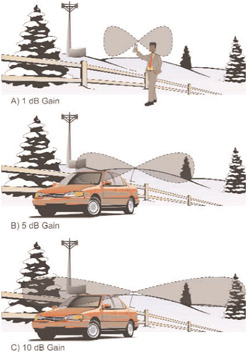
Antenna gain is the ratio of energy that is supplied to an antenna to the amount of energy transmitted from the antenna in a specific direction. The antenna gain is usually referenced to the direction of maximum radiation.
It is not always desirable to have antenna gain. For example, handheld telephones typically have only a small amount of antenna gain so they can transmit equally in most directions.
Figure 1.17 shows antenna systems that have different amounts of gain (directivity). In this example, a handheld telephone has a small amount of gain so they can transmit equally in most directions. The antenna that is mounted on a car can have more gain (directivity), as it will not be tilted (changed angle) as much as the portable telephone.
The gain of an...