Vacuum Deposition onto Webs, Films, and Foils
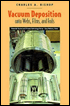
Written to guide operators and engineers as an onsite consultant would, this unique reference provides a broad appreciation of roll-to-roll vacuum deposition systems and processes.
 TABLE OF CONTENTS
 The word vacuum is derived from the Latin word "vacua" meaning empty. If we empty a chamber of gas, we produce a vacuum.
A vacuum could be described as the space within an enclosed volume where there is less gas per unit volume than is present in a similar volume in the atmosphere surrounding the enclosed volume. This is something that can be used to our advantage.
Those of us who drink tea have all heard tales of not being able to brew a good cup of tea when on the higher slopes of Mount Everest because of the lower pressure and the problem of boiling water at a lower temperature. This effect of reducing the boiling point of materials when under vacuum is one advantage that can be used to good effect.
Many materials, particularly when their temperature is raised to the boiling point, are prone to oxidation. Thus another advantage of operating in a vacuum is that materials that would normally be excessively affected by oxidation can have oxygen and water vapor kept away. This is achieved by being within a volume where there are few gas molecules (i.e.,...