Vacuum Deposition onto Webs, Films, and Foils

Written to guide operators and engineers as an onsite consultant would, this unique reference provides a broad appreciation of roll-to-roll vacuum deposition systems and processes.
 TABLE OF CONTENTS
 The drum surface roughness determines the number of contact points per unit area. The greater the number of contact points, the greater the heat transfer.
Typically, a 1 microinch mirror finish is required. There is no point in obtaining this quality of finish if it is not maintained well. This means that operators need to be trained to understand why scraping the surface with a screwdriver is an inappropriate way of cleaning and how a damaged surface can lead to web wrinkles.
It is relatively easy to manufacture polymer webs with a high-quality smooth finish. However, if both sides of the polymer are equally smooth the polymer will block when wound in vacuum. The reason for this is that in vacuum there is no air to act as a lubricant to help the polymer web to move over the preceding layer during winding.
To solve this problem it is common to find one side of the polymer rougher than the other. The smooth side is the side that gets coated and hence the rough side would be the one in contact with the deposition drum. The method of obtaining the roughness is often by the inclusion of fillers into one side of a coextruded polymer (Fig. 21.1).
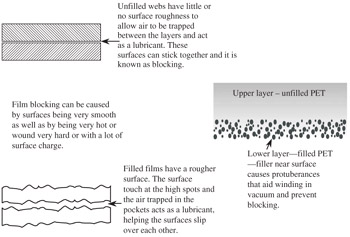
This difference in number and size of fillers can be one of the reasons why different manufacturers...