Vacuum Deposition onto Webs, Films, and Foils
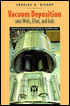
Written to guide operators and engineers as an onsite consultant would, this unique reference provides a broad appreciation of roll-to-roll vacuum deposition systems and processes.
 TABLE OF CONTENTS
 If a tube containing a cathode and an anode, which are positioned some distance apart, is evacuated and an inert gas is introduced, it is possible, when a potential is applied to the electrodes, to stimulate the system and for it then to become luminous. This emission of light is referred to as a glow discharge or plasma. The basic process that occurs is that when enough potential is applied across the gas, electrons collide with atoms to produce ions and more electrons. This process is initially in a cascade process that subsequently becomes a steady-state process. The electrons that are generated are called secondary electrons and may be further accelerated by the applied voltage. This acceleration means that they too are able to undergo ionizing collisions. The ions being substantially larger in mass are unable to be accelerated at the same rate as the electrons. This differing mobility is seen in the plasma as areas of differing light intensity.
The process of ionization is where an electron collides with an atom (or molecule) and removes an electron from the atom. For this to occur the kinetic energy of the impinging electron must be...