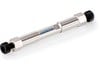
Help with HPLC Columns specifications:
Column Type
Back to Top

|
| ||
| Column Type: | |||
| Your choices are... | |||
| Analytical Column | This is the column where the sample separation actually takes place. | ||
| Guard Column | Guard columns remove particulate contaminants and highly adsorptive compounds from samples, prolonging analytical column life. | ||
| Search Logic: | All products with ANY of the selected attributes will be returned as matches. Leaving all boxes unchecked will not limit the search criteria for this question; products with all attribute options will be returned as matches. | ||
| |||
Stationary Phase/Separation Process
Back to Top
|
|
| ||
| Stationary Phase/Separation Process: | |||
| Your choices are... | |||
| Normally Bonded Phase | The stationary bed is strongly polar in nature and the mobile phase is non-polar. Polar samples are thus retained on the polar surface of the column packing longer than less polar materials. Good for water-sensitive samples, analytes that are insoluble in water, certain geometric isomers that are difficult to separate by reversed-phase, and class separations. Organic solvents used in normal-phase separations are more Mass Spectroscopy (MS) friendly than some of the typical buffers used in HPLC. In reversed-phase HPLC, operating conditions sometimes must be dramatically modified to allow compatibility with MS detection. | ||
| Reversed Phase | The inverse of normal phase chromatography. The stationary bed is non-polar (hydrophobic) in nature, while the mobile phase is a polar liquid, such as mixtures of water and methanol or acetonitrile. The greater the non-polarity of the material, the longer it will be retained. | ||
| Size Exclusion | The column is filled with material having precisely controlled pore sizes, and the sample is screened or filtered by the stationary phase according to its solvated molecular size. Larger molecules are rapidly washed through the column, and smaller molecules penetrate the pores of the packing particles and elute later. | ||
| Ion Exclusion | The anions are retained longer on the stationary phase than on anion-exchange columns. Quantification is therefore simplified in the event large amounts of cationic contaminants are present in the sample. | ||
| Ion Exchange | The stationary bed has an ionically charged surface of opposite charge to the sample ions. This technique is used almost exclusively with ionic or ionizable samples. The stronger the charge on the sample, the stronger it will be attracted to the ionic surface and thus, the longer it will take to elute. The mobile phase is an aqueous buffer, where both pH and ionic strength are used to control elution time. | ||
| Other | Other unlisted or proprietary separation process. | ||
| Search Logic: | All products with ANY of the selected attributes will be returned as matches. Leaving all boxes unchecked will not limit the search criteria for this question; products with all attribute options will be returned as matches. | ||
| |||
Construction Material
Back to Top
|
|
| ||
| Construction Material: | |||
| Your choices are... | |||
| Glass | A homogeneous material with a random, liquidlike (non-crystalline) molecular structure. The manufacturing process requires that the raw materials be heated to a temperature sufficient to produce a completely fused melt, which, when cooled rapidly, becomes rigid without crystallizing. | ||
| Steel - Stainless | Stainless steel is chemical and corrosion resistant and can have relatively high pressure ratings. | ||
| Polymer | Any number of plastic polymers. | ||
| Search Logic: | All products with ANY of the selected attributes will be returned as matches. Leaving all boxes unchecked will not limit the search criteria for this question; products with all attribute options will be returned as matches. | ||
| |||
Packing Specs
Back to Top
|
|
| ||
| Packing Material Diameter: | The diameter of the particles of the packing material. | ||
| Search Logic: | All matching products will have a value less than or equal to the specified value. | ||
| |||
| Pore Diameter: | The diameter of the pores present in the packing material. | ||
| Search Logic: | All matching products will have a value less than or equal to the specified value. | ||
| |||
Dimensions
Back to Top
|
|
| ||
| Column Length: | The length of the column. | ||
| Search Logic: | User may specify either, both, or neither of the "At Least" and "No More Than" values. Products returned as matches will meet all specified criteria. | ||
| |||
| Internal Diameter: | The inner diameter of the column. | ||
| Search Logic: | User may specify either, both, or neither of the "At Least" and "No More Than" values. Products returned as matches will meet all specified criteria. | ||
| |||
Operating Pressure
Back to Top
|
|
| ||
| Operating Pressure: | Pressure range that the column will operate within. | ||
| Search Logic: | User may specify either, both, or neither of the limits in a "From - To" range; when both are specified, matching products will cover entire range. Products returned as matches will meet all specified criteria. | ||
| |||
Environment
Back to Top
|
|
| ||
| Operating Temperature: | This is the full required range of ambient operating temperature. | ||
| Search Logic: | User may specify either, both, or neither of the limits in a "From - To" range; when both are specified, matching products will cover entire range. Products returned as matches will meet all specified criteria. | ||
| |||