Refining Processes Handbook
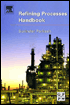
Filled with handy process flow diagrams, this comprehensive reference covers the technologies and operations of petroleum refineries and provides material on operating a jointly owned and operated refinery.
 TABLE OF CONTENTS
 Water is used in an oil refinery for the following purposes:
Cooling.
Steam generation.
Domestic and sanitation purposes.
Washing products.
Flushing equipment, pipelines, and hydrotests.
Fire fighting.
Water usage in the refinery also generates large volumes of water contaminated with oil and other chemical impurities. Part of this water can be reused after treatment, while the remainder must be discharged to sea or other water bodies. But, before this can be done, the aqueous effluent must be treated to remove oil, chemical, biological, and other impurities, so that the impact on the environment is minimal. The principle wastewater streams that require treatment are oily water effluents, biological waste generated by the refinery workforce, and sour water streams containing dissolved H 2S and NH 3.
Refining operations are conducted at elevated temperatures. In a rough overall sense, a refinery must be in heat balance. All heat added in the forms of fuel burned, steam consumed, or coke burned must be removed by one of the various cooling systems. Water cooling is one such system. The others are air cooling and heat exchange with other streams. Cooling accounts for about 90% of the total refinery water requirements. Approximate cooling water requirements of a refinery can be estimated as a function of refinery complexity. [1]
Water in a refinery s cooling system either travels through the system once or is recirculated. In a once-through system, pumps suction water from a source, such...