Refining Processes Handbook
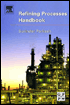
Filled with handy process flow diagrams, this comprehensive reference covers the technologies and operations of petroleum refineries and provides material on operating a jointly owned and operated refinery.
 TABLE OF CONTENTS
 First, the cause of difference between the actual refinery production and combined DOP is investigated and the delta allocated to the participants according to following rules.
For grades where only one participant requests production in its DOP. The delta is allocated to the participant with the DOP request as shown in following example. Consider a fixed grade I-390. Comparing the combined DOP for I-390 with its actual refinery production shows a delta of 7879 barrels. The entire delta is allocated to participant AOC, as BOC did not request production of this grade in its DOP:
| PARTICIPANT | DOP, bbl | DELTA, bbl |
|---|---|---|
| AOC | 55300 | 7879 |
| BOC | 0 | 0 |
| TOTAL | 55300 | 7879 |
| ACTUAL PRODUCTION | 63179 | |
| DELTA | 7879 |
For a grade where both participants request production in their DOP. Delta is allocated in the ratio of their DOP requests. However, if allocation by this rule causes negative closing inventory to a participant, the delta should be changed:
| PARTICIPANT | DOP | DOP RATIO | DELTA | LIFTING | OPENING INVENTORY | CLOSING INVENTORY |
|---|---|---|---|---|---|---|
| AOC | 69185 | 0.8279 | 20126 | 98000 | 5260 | ?3429 |
| BOC | 14384 | 0.1721 | 4184 | 0 | 3400 | 21968 |
| TOTAL | 83569 | 1.0000 | 24310 | 8660 | 18539 | |
| PRODUCTION | 107879 | |||||
| DELTA | 24310 |
In this case, splitting the delta in the DOP ratio has caused negative closing inventory due to overlifting by one participant. Here, AOC s delta is made equal to (lifting opening inventory DOP) to eliminate the negative closing inventory as follows:
| PARTICIPANT | DOP | DELTA |
|---|