Refining Processes Handbook
Filled with handy process flow diagrams, this comprehensive reference covers the technologies and operations of petroleum refineries and provides material on operating a jointly owned and operated refinery.
 TABLE OF CONTENTS
 Hydrotreating processes aim at the removal of impurities such as sulfur and nitrogen from distillate fuels naphtha, kerosene, and diesel by treating the feed with hydrogen at elevated temperature and pressure in the presence of a catalyst. Hydrotreating has been extended in recent years to atmospheric resids to reduce the sulfur and metal content of resids for producing low-sulfur fuel oils. The operating conditions of treatment are a function of type of feed and the desulfurization levels desired in the treated product. The feed types considered here are
Naphtha.
Kerosene.
Gas oils.
Atmospheric resids or reduced crudes.
The principal impurities to be removed are
Sulfur.
Nitrogen.
Oxygen.
Olefms.
Metals.
The basic reactions involved are outlined in Figure 2 1.
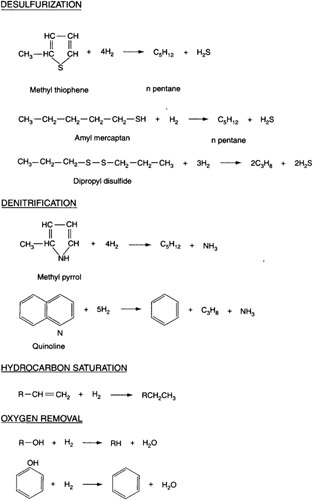
The sulfur-containing compounds are mainly mercaptans, sulfides, disulfides, polysulfides, and thiophenes. The thiophenes are more difficult to eliminate than most other types of sulfur.
The nitrogen compounds inhibit the acidic function of the catalyst considerably. These are transformed into ammonia by reaction with hydrogen.
The oxygen dissolved or present in the form of compounds such as phenols or peroxides are eliminated in the form of water after reacting with hydrogen.
The olefinic hydrocarbons at high temperature can cause formation of coke deposits on the catalyst or in the furnaces. These are easily transformed into stable paraffinic hydrocarbons. Such reactions are highly exothermic. Straight run feeds from the crude unit usually contain no olefins. If, however, the feed contains a significant amount of olefins, a liquid...