Refining Processes Handbook
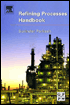
Filled with handy process flow diagrams, this comprehensive reference covers the technologies and operations of petroleum refineries and provides material on operating a jointly owned and operated refinery.
 TABLE OF CONTENTS
 Delayed coking is a thermal process in which the vacuum residue from crude distillation is heated in a furnace then confined in a reaction zone or coke drum under proper operating conditions of temperature and pressure until the unvaporized portion of the furnace effluent is converted to vapor and coke.
Delayed coking is an endothermic reaction, with the furnace supplying the necessary heat for the coking reactions. The reactions in the delayed coking are complex. In the initial phase, the feed is partially vaporized and cracked as it passes through the furnace. In the next step, cracking of the vapor occurs as it passes through the drum. In the final step, successive cracking and polymerization of the liquid confined in the drum takes place at high temperatures, until the liquid is converted into vapor and coke.
The coke produced in the delayed coker is almost pure carbon containing some of the impurities of the feed, such as sulfur and metals.
The reduced crude or vacuum resid enters the coke fractionator bottom surge zone (see Figure 6 1). The feed is mixed with recycle condensed in the bottom section of the fractionator and pumped by heater charge pump P-04 through coke heater H-01, where the charge is rapidly heated to the desired temperature for coke formation in the coke drums. Steam is injected in each heater coil to maintain the required minimum velocity and residence time and suppress the formation of coke in the heater coils.