Theory and Design of Microwave Filters

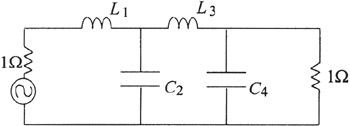
This book is concerned with the design of passive RF and microwave filters. These devices are manufactured using a variety of technologies, e.g. coaxial resonators, microstrip, waveguide etc. However, they are normally designed using lowpass prototype networks as a starting point, regardless of the eventual physical realisation. Lowpass prototype networks are two-port lumped element networks with an angular cut-off frequency of ? = 1, operating from a I ? generator into a I ? load. A typical lowpass prototype network is shown in Figure 2.1.
The design of lowpass prototype networks is dealt with in detail in Chapter 3. In this chapter we develop useful techniques for the analysis and synthesis of such networks. These network methods assume a basic understanding of Laplace transform theory and of the operation of inductors, capacitors and resistors. We will restrict ourselves to linear, time-invariant, passive networks, which are defined as follows.
First we consider a one-port network (Figure 2.2). This one-port network is excited by a voltage v( t) producing a current flow i(t). The Laplace transform of the voltage is V( p) and the resultant current is I( p).
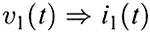
If a voltage v 1( t) across the terminals of N produces a current i 1( t) then
| (2.1) | |
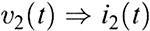
Similarly
| (2.2) | |
Now if the network...