Theory and Design of Microwave Filters

6.2: Basic Theory of Waveguides

6.2 Basic Theory of Waveguides

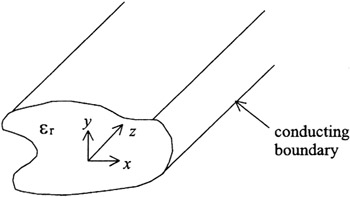
A waveguide normally consists of a hollow conducting pipe of arbitrary cross-section (Figure 6.1). In the ideal case both the conductor and the dielectric filling the waveguide are assumed lossless.


Figure 6.1: Uniform waveguide with arbitrary conducting boundary

Analysis of the possible field structures within the guide is accomplished by solution of Maxwells equations, which for sinusoidal excitation are

(6.1)
(6.2)

(exp( j ?t) dependence assumed) and for a source-free region

(6.3)
(6.4)

Taking the curl of (6.1) and substituting (6.2) we obtain

(6.5)

or

(6.6)

and from (6.3), for source-free regions, we obtain the Helmholtz equations

(6.7)
(6.8)

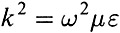
where

(6.9)

If we assume that the direction of propagation is along the z axis then the fields can be expressed in terms of the propagation constant ?:

(6.10)

where for a lossless waveguide ? = ? implies an exponentially decaying or cut-off wave and ? = j ? implies a propagating wave with sinusoidal variation along the z axis. The Helmholtz equations can be expressed as

(6.11)
(6.12)

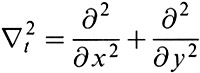
where

(6.13)

The E and H fields can be obtained by solving (6.11) and (6.12) with the appropriate boundary conditions, which in this case are that the tangential E field should be zero on the surface of the conducting pipe. General expressions for the fields in waveguides of arbitrary cross-section are difficult to obtain. Fortunately most practical waveguides have simple rectangular or circular cross-sections. Initially we...

UNLIMITED FREE
ACCESS
TO THE WORLD'S BEST IDEAS

SUBMIT
Already a GlobalSpec user? Log in.

This is embarrasing...

An error occurred while processing the form. Please try again in a few minutes.

Customize Your GlobalSpec Experience

Category: RF Waveguide Transition Adapters
Finish!
Privacy Policy

This is embarrasing...

An error occurred while processing the form. Please try again in a few minutes.